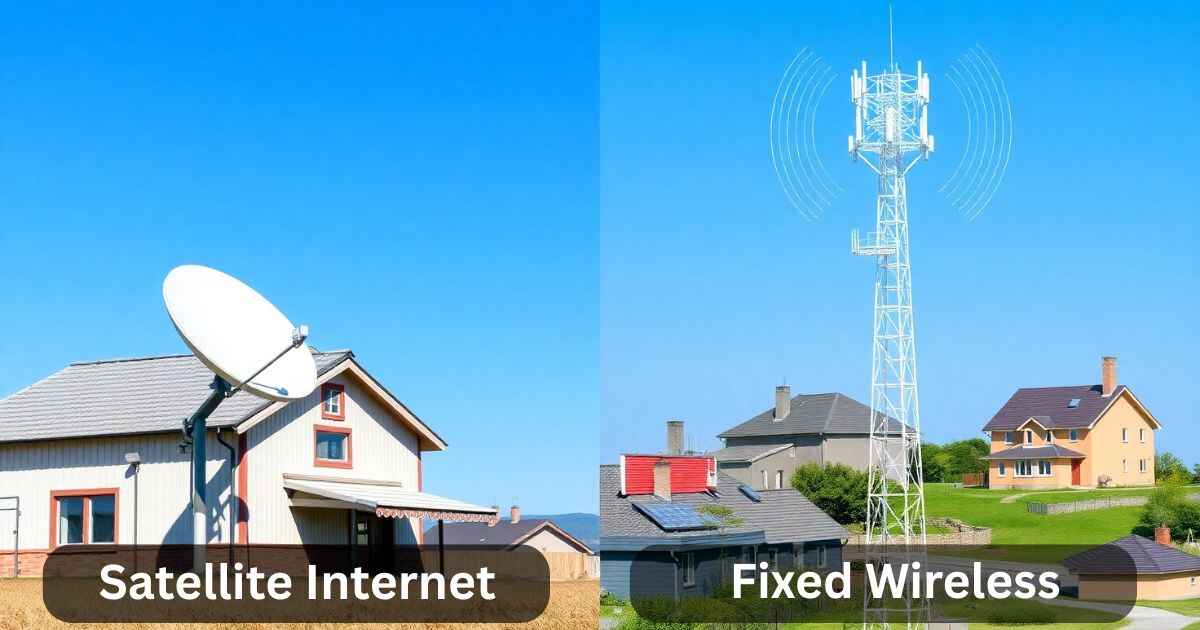
Choosing the right internet service is always crucial for rural households, since access to traditional cable and fiber is not widely available. As of 2025, Satellite Internet vs Fixed Wireless competition is intense, with each technology developing rapidly to ensure better coverage, speed, and reliability. Let’s dive in and go through key differences, recent developments, and the option that best fits your rural internet requirements.
Satellite Internet vs Fixed Wireless: Key highlights
Satellite Internet and Fixed Wireless are the most important types of wireless internet service for those living beyond the reach of cable or fiber lines.
- Satellite internet uses data tunnels to transmit data from orbiting satellites to a dish at your home, with Starlink Internet and HughesNet Internet among the foremost providers giving national coverage of satellite, thus almost anywhere where the dish sees the sky.
- Fixed wireless sends data at high speed directly from a ground-based tower near the house toward an antenna located on the house. It operates on a clear line of sight and generally exists within 10 miles of a tower, most probably on rural and agricultural lands.
Claim Your $100 Discount—Call Now: +1(855)375-6541
Speed and Reliability: Satellite Internet vs Fixed Wireless
- Satellite Internet: With recent advances, especially with LEO satellite deployment, speeds can now touch 100–220 Mbps, challenging cable speeds in certain locations. But weather (rain, storm, snow) and high altitude travel distances increase latency in the propagation of the signal, making occasional video calls and gaming from time to time an experience in sluggishness.
- Fixed Wireless Internet: The best rural fixed wireless Internet nowadays can provide speeds from 25 Mbps to 300 Mbps-upper-end, with a considerably low latency since the signal has to travel only a few miles. Fixed wireless is not highly affected by weather, but it has to keep electricity running from both the tower and the customer's end.
Data Limits and Pricing: satellite Internet vs Fixed Wireless
- With most satellite internet plans come data caps; users' connections are throttled or charged beyond a threshold. Starlink, for example, recently started to provide unlimited data at a lower point of entry.
- Fixed Wireless Price: Most fixed wireless providers feature high data caps or no data caps. The average price of such plans ranges from $50 to $70 a comfortable amount for rural users.
Call Now: +1(855)375-6541
Installation and Availability: Satellite Internet vs Fixed Wireless
- Satellite: Provided almost anywhere with a clear sky, installation comprises mounting a satellite dish and a modem. It is great for remote farms or off-the-grid cabins.
- Fixed Wireless: Faster to install (a small antenna or receiver is all that's needed), but the service areas are restricted to regions closer to a provider's tower. A line of sight can be obstructed by hills, trees, or even buildings.
Which Is Better for Your Rural Home?
If your home is completely isolated with no cell or wired alternatives, then the newest Satellite Internet would probably be your only option to connect. Should there be a fixed wireless provider in your vicinity, you, in most cases, would have faster speeds, lower latency, and much fewer weather interruptions at much better prices.
Call Now: +1(855)375-6541Wrap Up!
While the Satellite Internet vs Fixed Wireless Internet decision is determined primarily by where the user is located and the needs of his/her household, fixed wireless tends to be the cheaper, and often the more reliable, choice for those who have access to it. As rural wireless Internet evolves, always check out different providers; check out the latest satellite Internet plans; and factor in installation, any limits on data, and the complete Fixed Wireless Price to ensure that your family gets the best sort of rural Internet available.